

Cybersecurity in 2026 is no longer a background IT function. It is a strategic layer that directly impacts growth, investor confidence, operational stability, and long term brand trust. After reviewing recent global risk outlooks and enterprise threat briefings from organizations such as World Economic Forum and Gartner, one thing is very clear to me. Cyber risk has become systemic, not situational.
What concerns me most this year is not just the volume of attacks but the intelligence behind them. Threat actors are operating like growth hackers. They test, iterate, automate, and optimize their attack models. If a business is still relying on static defense tools purchased three years ago, it is already behind. In my view, 2026 demands structural resilience, not surface level protection.
The Defining Cybersecurity Threats of 2026
AI Powered Attacks Are Scaling Faster Than Human Teams
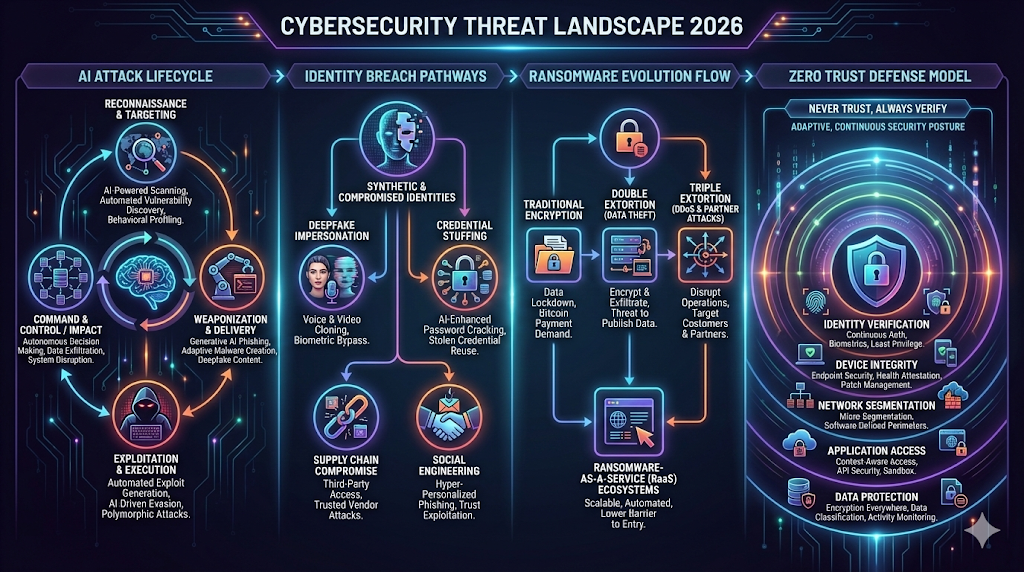
Artificial intelligence is now deeply embedded in both defense and offense. Attackers use AI to automate reconnaissance, generate highly personalized phishing messages, and modify malware signatures in real time. According to recent global security outlooks referenced by the World Economic Forum, automation is dramatically increasing attack velocity.
What used to be mass phishing is now precision targeting. Emails reference current projects, internal terminology, and real executive names. AI systems test thousands of message variations and learn from response behavior. From my perspective, this shifts the battle from reactive filtering to predictive detection. Businesses must assume attackers are learning faster than ever.
Key AI enabled risks include:
- Hyper personalized phishing campaigns
- Automated vulnerability scanning
- Adaptive malware that evades signature based detection
- AI generated social engineering scripts
This is not theoretical anymore. It is operational.
Identity Is the New Security Perimeter
Most breaches in recent years have not involved dramatic technical exploits. They begin with compromised credentials. Stolen passwords, token reuse, excessive access privileges, and poorly monitored administrator accounts remain common entry points.
In hybrid cloud environments, identity connects everything. Employees access SaaS tools, cloud infrastructure, internal dashboards, and APIs from multiple devices and networks. When identity governance is weak, the entire architecture becomes vulnerable. I strongly believe identity strategy is the highest return security investment in 2026.
Core identity priorities should include:
- Multi factor authentication everywhere
- Strict least privilege access policies
- Regular access audits and privilege reviews
- Continuous session monitoring
When access pathways are tightly controlled, the attack surface shrinks dramatically.
Ransomware Has Evolved Into Strategic Extortion
Ransomware is no longer about encrypted files alone. Modern attackers combine encryption, data exfiltration, operational shutdown, and public exposure threats. Even if backups restore systems, leaked data can create long term reputational and regulatory consequences.
I have noticed that timing has become a strategic weapon. Attackers often strike during high revenue periods, product launches, or critical operational windows. This increases pressure to pay quickly. That psychological dimension makes preparation even more critical.
Businesses must move beyond backup discussions and focus on:
- Incident response rehearsals
- Legal and communications coordination
- Clear executive decision protocols
- Segmented network architecture to contain spread
Preparedness determines recovery speed.
Supply Chain and Third Party Risk Is Expanding
Modern businesses depend on interconnected ecosystems. Cloud providers, analytics platforms, marketing tools, contractors, and outsourced developers all form part of the digital supply chain. A vulnerability in one partner can cascade into multiple connected environments.
In 2026, vendor risk is no longer a compliance checkbox. It is a live exposure channel. I often advise that companies treat third party access as if it were internal infrastructure. If a vendor can access critical systems, that vendor effectively becomes part of your security perimeter.
Strategic vendor protection should include:
- Formal security assessments before onboarding
- Contractual security obligations
- Continuous monitoring of third party risk signals
- Software bill of materials tracking where applicable
This is where many mid sized businesses underestimate their exposure.
Deepfakes and Advanced Social Engineering
AI generated voice and video impersonations are becoming credible enough to influence financial approvals and executive level communication. Combined with contextual data scraped from public sources, these attacks are disturbingly convincing.
Traditional awareness training focused only on suspicious links is no longer enough. Employees must understand verification culture. Sensitive actions should require layered confirmation, especially for financial transfers and privileged access changes.
In my opinion, organizations must shift from trust based workflows to verification based workflows. That cultural adjustment is subtle but powerful.
Strategic Cybersecurity Priorities for 2026
Threat awareness is only half the equation. Execution is what determines resilience. After reviewing industry frameworks and enterprise strategy reports, five structural priorities stand out.
Implement Zero Trust Architecture
Zero Trust means continuous verification rather than assumed trust. Every user, device, and system interaction is authenticated and validated regardless of location. This significantly reduces lateral movement if a breach occurs.
Zero Trust is not a single product. It is an architectural mindset supported by:
- Micro segmentation
- Context aware authentication
- Device posture validation
- Continuous monitoring
Breaches will happen. Containment is the real objective.
Elevate Cybersecurity to Executive Governance
Cybersecurity should appear in boardroom dashboards alongside financial risk. Research from firms such as Gartner increasingly emphasizes the need for measurable cyber risk reporting.
When executives understand downtime cost, regulatory exposure, and brand impact, security investment becomes strategic rather than reactive. I believe companies that integrate cybersecurity into enterprise risk management frameworks will outperform competitors over time.
Invest in AI Augmented Defense
If attackers use AI, defenders must use AI as well. Modern detection systems analyze behavioral anomalies across massive datasets and automate response actions within seconds.
However, I would caution against tool overload. AI driven security tools must integrate into clear incident response workflows. Otherwise, organizations face alert fatigue and decision paralysis.
Build Organizational Response Muscle
The worst time to build a crisis plan is during a crisis. Tabletop simulations, executive drills, and cross department rehearsals dramatically improve response efficiency.
A strong incident response framework includes:
- Defined escalation paths
- Clear communication protocols
- Legal and regulatory notification procedures
- Post incident review cycles
Security is as much about organizational clarity as technical defense.
Why Cybersecurity Is a Competitive Advantage in 2026
Customers, partners, and regulators increasingly evaluate companies based on trust. Strong cybersecurity posture reduces not only breach risk but also reputational vulnerability. In a digital first economy, trust is currency.
From my perspective, cybersecurity is no longer a cost center. It is infrastructure for sustainable growth. Businesses that invest strategically will experience fewer disruptions, stronger partner confidence, and greater long term stability.
In 2026, resilience is not optional. It is a growth strategy.